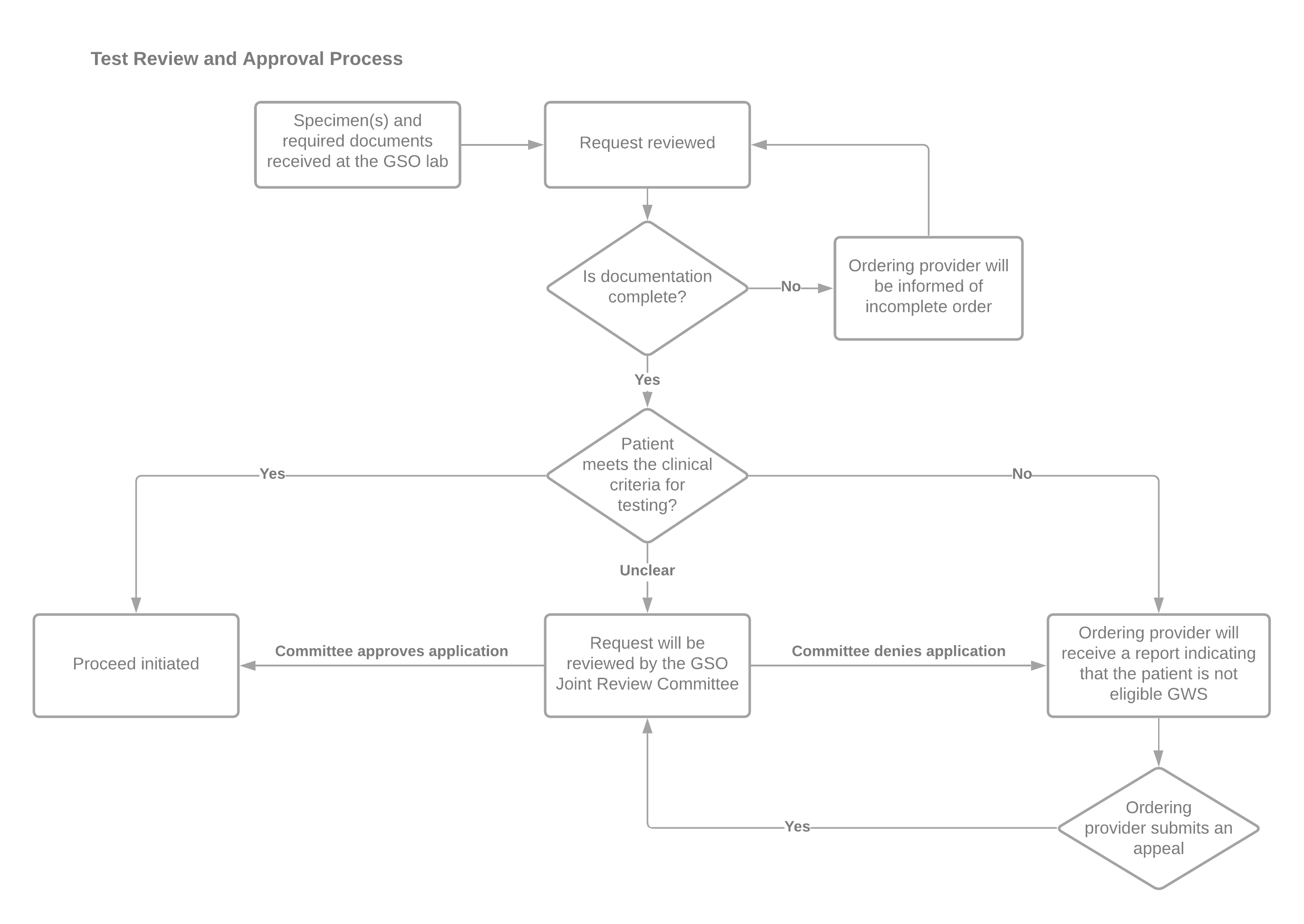
All patients for whom genome-wide sequencing (GWS) is ordered must meet the MOH patient eligibility criteria for funding as outlined in the requisition. Test orders will be reviewed by a SickKids or CHEO genetic counsellor.
Incomplete applications may delay review and adjudication of test approval, as well as turnaround time. Test orders with incomplete information will not be processed; the laboratory will store the sample and request additional information prior to initiating testing.
Test orders that may not meet testing criteria will be reviewed by the GSO Joint Review Committee consisting of, at minimum, one clinical geneticist, one clinical molecular geneticist, as well as one genetic counsellor from each site. The committee members will be blinded to the origin of each test submission and will determine the eligibility of the case based on the clinical information provided. Ordering physicians will be notified if a request does not meet criteria for GWS. Providers may appeal decisions by submitting additional clinical information and justification for the test to the joint committee.
If a comprehensive gene panel (i.e., ≥100 genes or where all known disease gene relationships are assessed) has been completed in the past three years and did not identify a causative pathogenic variant but there is a strong argument to be made for GWS, a letter providing the exceptional circumstances of the case, in addition to the usual documents for review (e.g., evolution of the phenotype, pregnancy), must be included.
Documents and images found on the GSO website can be requested in alternative forms such as plain language or accessible electronic format as part of our commitment to Accessibility. To request information in an alternative format please email gso@cheo.on.ca or call 613-737-7600 ext. 3796.
Testing should be completed on the affected individual. Additional affected relatives or unaffected parents, when available, can be analyzed concurrently to facilitate and improve variant interpretation:
- Trios (proband and both biological parents) are the preferred GWS analysis strategy for all undiagnosed patients, with a few exceptions. Parental samples when possible, should be submitted alongside the proband sample to allow concurrent analysis.
- If parents are not available for concurrent analysis, other sequencing strategies can be considered and samples from alternate family members may be submitted for concurrent analysis.
- If autosomal recessive inheritance is suspected, including in the context of consanguineous families, samples from additional affected individuals (e.g., sibling) may be submitted for concurrent analysis in addition to the parents.
- If X‐linked inheritance is suspected, both parents should still be included for trio analysis when possible. If a better suited targeted X-linked panel is available, the panel approach should be prioritized. In very rare instances of clear X-linked inheritance, samples from other family members may be submitted for comparative analysis, after discussion with the diagnostic laboratory.
- In instances of very clear autosomal dominant inheritance, samples from different family members may be helpful in the analysis and can be submitted for comparative analysis after discussion with the diagnostic laboratory.
- If a disorder associated with variants in the mitochondrial genome is suspected, a targeted clinical test designed to assess the mitochondrial genome should be performed.
- If the patient has a phenotype highly specific to a known genetic condition for which an optimized genetic panel exists, or for which all known gene‐disease associations can be assessed, a targeted gene panel should be given priority assuming it is more sensitive (e.g., Noonan spectrum disorders).
- Please note, a separate analysis is not performed on samples from family members; they are used for the purposes of interpreting the proband’s results.